Office Politics

What is Office Politics?
Around 1936, Dale Carnegie defined office politics as, “a skill in human engineering” as being one of the prime factors for business success.  Office politics is also called, “manipulation, ambition, aggression, harassment or human nature.”  Office politics to a certain extent can involve money whereas studies of the National Organization for Women (NOW) calculated that there will be approx $1 billion dollars of lawsuits that will be settled in the next five years.  This means companies will need to consider office politics as a significant contribution to its operations when money is involved.

Office politics is not always negative, as it is stated that in order to advance in your career you must also be politically aware as it is important for you to be able to sell your ideas, promote your credibility as well as exposing your skills.

Being in an office environment, people will build relationships with one another as bad office politics scenarios are caused by, “insecurity, immaturity, personalities, ambition, and human nature.”  As stated by Prof Arthur Brief, people go to work to, “satisfy higher psychological needs such as, achievement, power, affiliation, autonomy, esteem, safety, security, equity, and self actualization.”

When groups of people work together, with many levels of hierarchy, there will be conflicts that take place between people.  These problems are due to things such as poor communication, failure to listen, and withholding information as ignoring these issues will only crumble an organization. 

Here are some tips that leaders can do to manage office politics:

1) Don’t ignore problems and hope they’ll go away.
2) Do not leave employees in the dark with information (mushroom theory of management, overcommunicate – meetings, memos, newsletters, etc.)
3) Compliment in memo form.
4) Hire self-confident people.
5) Manage conflict with patience, listening, weighing the issues, avoiding defensiveness, remain objective & cooperative, admitting mistakes, accepting valid reason & evidence and lastly to avoid assumptions (spell out details, agreements in writing & summarize progress).
6) Managers should follow the same rules imposed to subordinates                
7) Promote based on performance.

In conclusion, companies are born to make money where as human organization defined through individuals working in offices all seek expression (socially, economically, part of a belonging, respect, friends, etc.). Leaders create the culture of an organization in which office politics are reflected on corporate culture.

Posted in Ordinary | Tagged | 1 Comment

PASCA SARJANA 10 BESAR PILIHAN EKSEKUTIF VERSI MAJALAH SWA JULI 2008

PASCA SARJANA 10 BESAR PILIHAN EKSEKUTIF VERSI MAJALAH SWA JULI 2008

PERGURUAN TINGGI PILIHAN EKSEKUTIF (JAWABAN GANDA)

Dalam Negeri (%)
Universitas Indonesia 76,19
Prasetya Mulya Business School 45,24
IPMI Business School 19,05
Universitas Gadjah Mada 16,67
PPM Graduate School of Management 14,29
Institut Teknologi Bandung 9,52
Universitas Padjajaran 9,52
Institut Pertanian Bogor 4,76
London School of PR 4,76
Universitas Mercu Buana 4,76
Universitas Parahyangan 4,76
Universitas Paramadina 4,76
Universitas Trisakti 4,76
Lainnya 9,52

Posted in Ordinary | Tagged , , , , | Leave a comment

Change Or Die

change_or_die

Change in business for a better business health correlates to change in your own behavior for personal health. The fierce business environment today leads to great pressures for success. With technology and internet taking its toll throughout businesses around the globe and playing a key role in business transactions, speed is vital for business success. Business executives are always on their toes to lead a lifestyle of constant intensity and fighting to win against competitors and winning the customer. This leads to many health issues amongst business executives. Even though statistics show that approximately 600,000 people have bypass heart surgery every year with approx 1.3 million heart patients to have angioplasties (procedure to improve blood flow to the heart and temporarily decreasing, all totaling to around 30 billion dollars, people still have a hard time of changing their behavior.

In business it is no longer about strategy, structure, culture or systems; it is about changing the behavior of people. To that extent, the title, “Change or Die”, literally means, “You either change your behavior in business, or you will die of a heart attack.”
With those numbers, people are seldom to change even after a crisis such as a heart attack.

Alan Deutschman speaks about in order to change people’s behavior, we need to talk to people’s feelings, motivate them to change. We don’t tell them to change because they will certainly not, and that is a consensus of 9 to 1 that people will not change in favor of 9.

He says that emotional persuasion to motivate change is not taught in business schools or in companies where professionals such as engineers, scientists, managers, lawyers, accountants, doctors, etc are too focused on day to day concrete analytical work. Professionals do not see the importance of emotional, psychological stability and turbulence to be important to business results.

So how do we get people to change their behavior to save their businesses and most importantly to save their lives?

The Ormish Program lead by Dr. Dean Ornish, professor of medicine at the University of California San Francisco, founder of the Preventative Medicine Research Institute, in Sausalito, California, has changed the motivation for change from the fear of dying, into the joy of living and feeling good about yourself. This change of motivation speaks to the feelings of people of chronic disease in changing their frame of thought.  In neuroscience, people think of concepts in their own mind frame as facts that don’t fit their mind frame often do not make sense. Persuading someone to change is not about giving facts to people, it is about changing their mind frame of thought or direction by making them feel good about themselves.

But it is not always about changing the mind frame, but creating a radical and instant change. Organizations and people tend to succeed more when instant and radical changes take place rather than slow and gradual change. This leaves people to be emotionally distressed because of impatience that they do not succeed. Radical change is important to instantly change behavior.

Changing behavior also needs support through the process of transformation. Without support, change will most likely not succeed.

Lastly, change deals with one’s brain.  The brain of the human being has been discovered as a plastically muscle that can be shaped throughout our lifetime with constant practice and usage. Change can be stimulated by what posit science calls a, “fifth day strategy,” meaning that employees within organizations spend 1 day to complete a task out of their comfort zone. For an example, software engineers work in marketing or designers involved in business functions such as accounting and operations.
Innovation and creativity can be achieved when people use both sides of their brain and intelligence rather than being controlled, told what to do, and work within corridors and boundaries.

We all must learn to master the art of change in order for us to have a healthy life in business and in our personal health. An important fact is that for heart patients, it is “change or die”, but for people with no heart problems and live life into our 80s, it is about, “change or lose your mind.”
We all must understand that we need to master the art of change to consistently live “the feel-good life”.

Posted in Ordinary | Tagged , , , , | Leave a comment

IPMI BUSINESS SCHOOL

photo-ipmi2It has been a little over one year since I have entered the MBA IPMI Business School program to vibe out every night with case studies to analyze while preparing for presentations almost on a daily basis. Some of the many things are consistently thinking about how ‘tos’ and ‘whys’, preparing to tackle readings, preparing assignments, arranging meetings with group, networking with awesome people and leaders of their field; And just basically molding myself being into the person I was born to be.

This year has been a phenomenal year with many transformational changes happening to myself with different aspects of my life.  I have to admit that IPMI Business School has changed my life for the better;  Not only on the hard skills of business such as marketing, accounting, operations, etc, but most importantly my intangibles such as problem solving skills, leadership, organization, behavior, attitude, etc, as those skills are keys for growth.  Those are some of the things that I have been thankful for this past year through IPMI.

It has also been a year of fast paced, moving, juggling projects, work and intensity with exhilarating outcomes.  If any Indonesian out there or foreigners are looking to study at a fine institution for a Masters business education , I would recommend IPMI Business School. -> http://www.ipmimba.ac.id

With the strong alumni and network amongst diverse industries, one wonders of the open opportunities for future endeavors.  I am a first hand witness of the power of IPMI Business School.

photo-ipmi1

Posted in Ordinary | Tagged , , | Leave a comment

Benjamin Soemartopo is Managing Partner of McKinsey & Company in Indonesia. Topic: “Developing World Class Leaders for Indonesia.”

1-august-8th-2009-0041

Today, I had the chance to sit-in for the IPMI Discussion Forum to celebrate IPMI’s 25th Anniversary of Excellence in Business Education with the topic of “Developing World Class Leaders For Indonesia” presented by the Managing Partner of Mckinsey & Company in Indonesia; Mr. Benjamin Soemartopo.

Mr. Benjamin spoke about different things including the rise of Indonesia’s future;  The eye on Indonesia amongst the International community and most importantly,  The need of 27,000 Indonesian World Class Leaders in a span of 10 years for Indonesia to move forward into a strong powerhouse nation.

Mr. Benjamin began by sharing to us the 6 schools of leadership theory, and they are:
– Traits : “Great Man Theory.”
– Behavioral
– Power
– Context
– Charismatic
– Transformational

He stated that the main point of leadership is, “leaders develop leaders”.  He explained that leaders can be extrovert or introvert and leaders can be made leaders or natural born leaders, but the most important thing is breakthrough results.  Results of significance of the greater good; In other words, results beyond expectation.

He also talked about that world class leaders need to understand developments amongst Indonesia & throughout the world within a span of 10 years in the future and knowing what is going on in your industry as well as your functional development all throughout the world.  He shared to us a link on the internet at mickenseyquarterly.com/whatmatters,  to read about further developments throughout the world.

Mr. Benjamin then told us that world class leaders must understand business, government and society as leaders are born on the job rather than off the job. For further self development, he stated that 70% of the 100% portion of leadership development is that one needs to stretch their jobs or stretch jobs of subordinates as well as find creative ways for solutions.  Where 20% is from Feedback and Mentoring/Coaching others and the last 10% would be formal training; such as public speaking and Team Building.

Other important points he mentioned:

herdianLead Self:

Understanding English/Indonesian;

Communication;

Conceptual/Problem Solve;

Don’t be shy to speak out;

Have the will;

Leadership interpersonal being.

Lead Change:

Strong Vision;

Dealing with resistance;

Managing Stakeholders.

Lead Others:

Leading a top team;

Coaching and Feedback.

How to delegate:

Have the authority to assemble a team;

Segment time to mentor & monitor according to performance members within different team personnel;

Monitoring by creating an owed task checklist for your team;

Continuous 2 way communication.

Lead Business:

Benchmarking with global peers.

1-august-8th-2009-0051

During the two hours of presentation and interactive session, I learned that leadership starts within yourself and those people you have developed as leaders all throughout your lives.  Leadership are born on the job as leaders have the highest level of initiative.

I have to admit I was inspired One hundred Fold in order for me to create significance into the greater good for my country, and this can be done starting with each and everyone of us.   There is no better time to pursue this leadership than right now.  Thank you very much for the inspiration Mr. Benjamin Soemartopo.  God bless you.

Posted in Ordinary | Tagged , , , , , , | 3 Comments

IPMI Business School – Reg Jan 2009/Jul 2008

Growing up as a teenager,  a few of my friends while hanging out would often bombard us within every few minutes to pull out their cameras to shoot some pictures.  During my time as a teen, I always remembered how annoying it was to pause within every few minutes of my “teeny” life to document our day to day living as if there was nothing better to do.

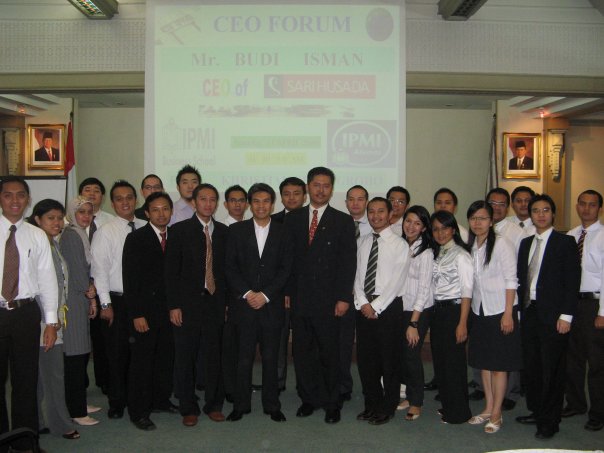
But as we get older to realize that our days are diminishing every second we live and breathe – we take a whole different perspective towards picture taking and documentation.  I’ve recently just realized the importance of documentation as an important aspect of my own life through the great friendships that we bond throughout our days.  The power of documenting pictures or videos is vital to make our days cherishable as well as connect with our inner and outer being of what truly matters in this short life time of ours.  Living simple, cherishing these moments are living norms that we everyday people can live by in order to engrave these precious moments that may never come by ever again.  To my Family and Friends, lets document the times of our lives.  Thank you MBA students & facilitators for making these moments unforgetable.  We are the future leaders of tommorow.ceo-forum-pak-budi-isman

Posted in Ordinary | Tagged , , , , , , , | Leave a comment

Semester 3 IPMI Business School

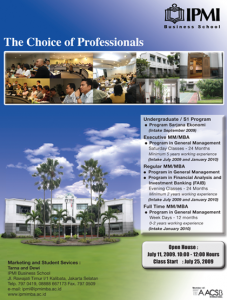
ipmi-brochureThese are the subjects for my third (3rd) semester MBA classes.  Lets have another great semester.  Any tips?

– Financial Management.

– Good Corporate Governance.

– Managing International Business.

– Business Law.

– International Finance.

– Group Field Project 1.

Posted in Ordinary | Leave a comment

Managerial Communications with Mrs. Amelia Naim Indrajaya, Ir.,MBA

buntegakIn today’s special post, I had the privilege to interview my last semester facilitator, Mrs. Amelia Naim Indrajaya, whom has taken her MBA students of IPMI Business School into a life evolving journey through her inspirational classes of Managerial Communications. One semester of pure inner & outer development that none of us wanted to end. As always, in today’s interview, she opens our perspective into the importance of Managerial Communications in today’s world, especially the importance of Managerial Communications for my third world country of Indonesia.

Enjoy the interview.

Herdian:

Hi Bu Amelia (we call her Bu, which means Ibu as in the Indonesian language which means mother as it is also used as a sign of respect and greeting equivalent to Ms. or Mrs in the English language), thank you very much for your time.Before we begin, can you please share to us your background?

Mrs. Amelia:

I came from a family who moves a lot. I was born in New York, spent my grammar school in Singapore and had been to school in Sumatera, Sulawesi, Java. My father is a Sociologist who’s also a writer. My mom is a lawyer. We have been raised up in a highly democratic culture. We were given freedom to choose our field of study. My Mom had even offer me to go seriously for music. But we all ended up in Bandung Institute of Technology (all 4 and I am the eldest). I had chosen Industrial Management as my major in ITB. I became interested to deal more on the people side so I chose to pursue MBA degree in University of Colorado at Boulder. I still have a dream of pursuing a PhD on spiritual management. Especially that we have seen the collapse of companies with the only target, gaining the most with the least input. We have seen also “exploitation de l’homme par l’homme”, where we see the the trickle up effect (Exploitation of people for a few “creme de la creme” of the society). I believe the answer is to delve deeper on the spiritual management aspect.


Herdian:

Why did you decide to teach managerial communications in IPMI? And what is your objective?

Mrs. Amelia:

Since my undergraduate study years, I have been involved in training projects with my lecturer in the subject of management. Some also dealt with interpersonal skill i.e communication. Later in Boulder, Colorado while pursuing my Master degree, I was also involved in conducting training also on the soft skill areas. With all this exposures and life experience, It seems like even though the system and procedure of a company is perfect, business could not thrive without good communication. That is both written and verbal. Communication could also influence the ambiance. It could spread out negative spirit or if the communication is handled positively, it could create an enormous positive energy. Especially when the communication is conducted with a good spiritual foundation, it has power beyond imagination. This is why I am keen to go deeper on this subject.

Herdian :

Why is managerial communications important for the success of our personal and professional life?

Mrs Amelia:

Why is it important for personal and professional life? Ups… imagine living with people you care… but they never got the idea that you care… or leading a bunch of people who hates you, because the lack of communication skill gave them the wrong impression. Well I don’t want to sound lecturing but put it in an easy way… then you could imagine how hard it is surviving in the world of humanity without a descent communication skill.


Herdian:

Also being a published author, writer and professional trainer, please share to us about your books, training and consultancy and how and where we can purchase them?

Mrs. Amelia:

Books, training and consultancy? Hm I really enjoy sharing. My books are just about that. Sharing the gifts of life, wisdom and spiritual journey. I have bila_nurani_bicara_1started to love training, way back since college. I belief that training is not just learning, but it is about feeling, going through an experiential learning feeling through a spiritual journey. I do not belief in segregation of knowledge. That is, science is a separate knowledge, and spiritual is a different subject altogether. I belief that everything to be learned in this world should be learned spiritually since we are a spiritual person, we were built that way. The segregation of knowledge have made our leaders became self centered, hard to live with, and life became a grudging gruesome feelings. That’s why my training programs be it on communication, leadership, supervisory management has a strong spiritual ambiance. And it is the universal spiritual values. Due to the books, writing columns for magazines, radio show, I’ve been invited for consultancies, speeches and sharing experiences. As long as I have the opportunity, I’ll be looking forward to help and share and counsel. I can be reached at amelianaim@yahoo.com. I can also be reached through the cell phone: 0818 924 263. I will answer the sms, but during class the cell will be turned off.

Herdian:

In reference to Indonesia, do you think many Indonesians lack “Empathy” when they communicate? Why or why not?

Mrs. Amelia:

Empathy? In Indonesia? We are so used to aristocracy, we have been ruled by kings for hundreds of years. If we are the leaders… we are so used to being served, people lined up to read your cues… etc. You don’t need to empathized. You are THE Leader. If you say the sky is yellow. Then everyone will say YESS MY king, ” it’s yellow”. That is the problem of Indonesian culture. When you are in the leading position, people would hesitate to say the truth. Yet now is the reformation era, people criticize each other openly even humiliate other people. That’s another extreme that we don’t agree either. So we should be just right, be Assertive, not passive as before, but NOT agressive like it is now.

Herdian:

In one of your lectures, you explained that being assertive is the ideal way of communicating as many Indonesians are either passive or aggressive when they communicate. How can Indonesians communicate more assertively and why is it important?

Mrs. Amelia:

Assertive… Now that’s a wonderful approach lead by our spiritual leader Mohammed. You got his name too right? I sure hope you could modeled his assertiveness spirit. Firm yet kind, determined yet gentle and achieving yet understanding.

Well we have talked in the class room that being assertive is a choice. Everyone has the potential to be assertive. Yet they usually start by being passive, and when they couldn’t bear it any longer they explode and becomes aggressive. How beautiful life could be if we can control ourselves and became assertive. Respecting difference. Believing that every problems has solutions. And opening up for new ways of thinking and accepting differences.

Herdian:

If you had to give one last piece of advice to share to all of us about anything, what would that advice be?

Mrs. Amelia:

bu-amelia-familyFor my last thoughts…. Uhm…

We can all be the agent of change. Don’t wait until things get easier, or people became more empathetical or the bosses to get back to his sanity. We can just start now with all the little things. We look upon ourselves as the leaders with His spirit to take care of the world as His trustees. We strive to be meaningful to everyone around, to the universe. Today is better than yesterday. And tomorrow is better than today. And get the positive spirit flow to all the people around you. Just do it one step at a time. And you will see the power of the positive spirit spread out through positive communication. Wish you all the best!
Posted in Ordinary | 11 Comments